
Your pool deck isn’t just a border around the water—it’s where your family lounges on Saturday afternoons, where kids cannonball off the edge, and where you host summer barbecues under string lights. In fact, most poolside time is spent on the deck, not in the pool. So when it comes to choosing the right pool decking material, the decision carries real weight.
The problem? Walk into any home improvement store or scroll through contractor portfolios, and you’ll be bombarded with pool decking options: natural hardwood, composite boards, interlocking pavers for pool deck installations, stamped concrete pool deck finishes, travertine stone, cool deck coatings—the list goes on. Each option comes with different price tags, maintenance demands, and performance characteristics that shift dramatically depending on whether you live in scorching Phoenix or humid Atlanta.
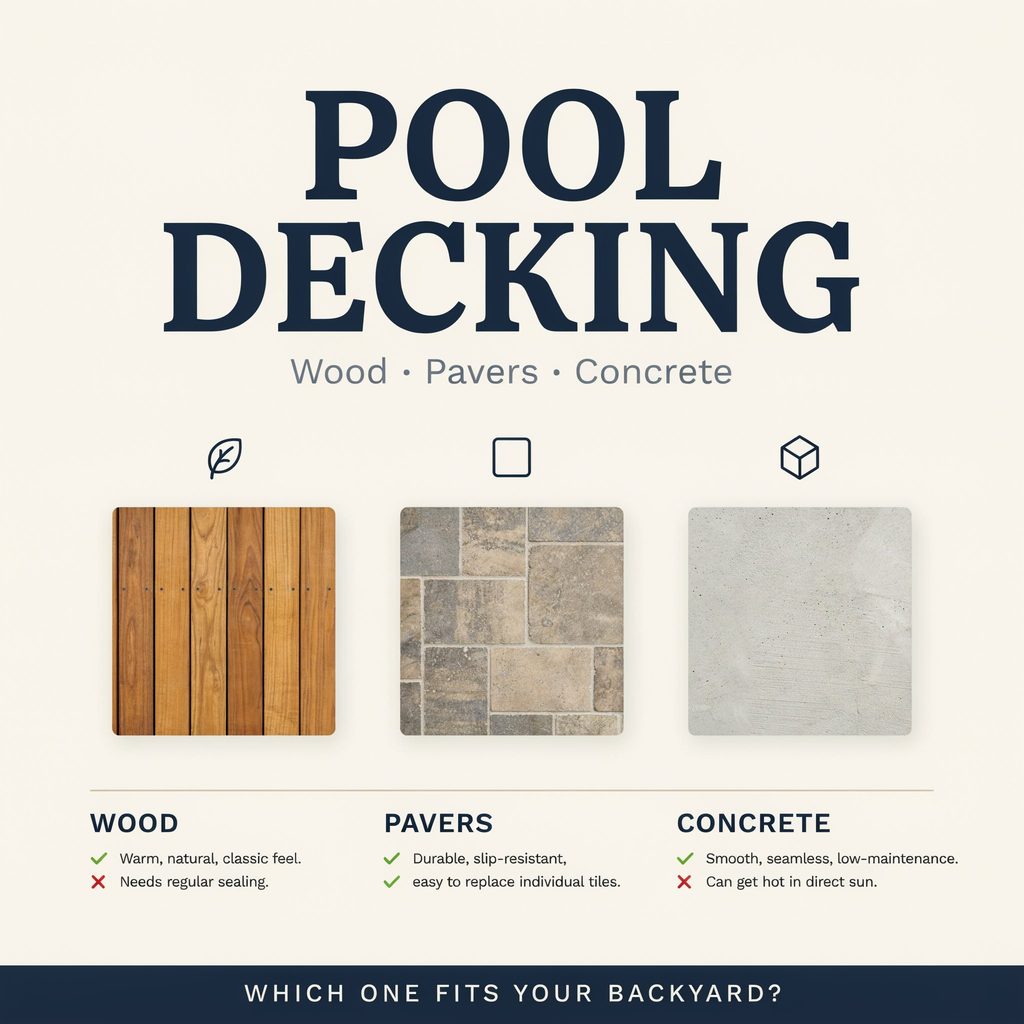
This guide cuts through the noise. We’ll break down wood, pavers, and concrete pool decking across cost, durability, maintenance, safety, comfort, and design flexibility. By the end, you’ll know exactly which material suits your budget, your climate, and your lifestyle—no sales pitch, just practical data.
Key Factors to Consider Before Choosing Pool Decking
Before comparing specific materials, nail down your priorities. The best pool deck material for your neighbor in Miami may be the wrong choice for your home in Minnesota. Here’s what to weigh:
Budget: Pool deck cost per square foot varies wildly—from $6 for basic concrete to $70+ for premium composite or natural stone. But don’t just look at the sticker price. Factor in pool deck installation cost, long-term sealing, repairs, and eventual replacement.
Climate & Heat: In Arizona, Florida, and Texas, surface temperatures on dark materials can exceed 150°F in July. Heat-resistant pool deck materials aren’t a luxury—they’re a necessity. Meanwhile, homeowners in the Northeast and Midwest must account for freeze–thaw cycles that crack rigid surfaces and heave poorly installed pavers.
Maintenance: Be honest about how many weekends you’ll dedicate to pool deck maintenance. Sealing wood every 1–2 years, re-sanding paver joints, or resealing concrete every 2–3 years all demand time and money.
Safety: Pool deck safety is non-negotiable, especially with children or elderly family members. Slip-resistant pool decking with adequate texture when wet should be a baseline requirement, not an upgrade.
Comfort: Barefoot comfort matters. A deck that radiates heat or feels rough underfoot will push everyone back into the water within minutes.
Design Flexibility: Pool deck design ideas range from rustic wood planks to intricate herringbone paver patterns. Consider how the material integrates with your landscaping, hardscape, and home’s architectural style.
Lifespan & Durability: Pool deck durability determines how long your investment lasts before major repair or replacement. Some materials gracefully age 25+ years; others show wear in a decade.
Wood Pool Decking
There’s a reason the classic wood pool deck endures in backyard magazines: nothing matches the warmth and organic texture of real timber. But “wood” is a broad category, and your experience will differ enormously depending on which type you choose.
Types of Wood Decking for Pools
- Natural hardwood (ipe, teak, mahogany): Dense tropical species prized for rich color, natural rot resistance, and extreme hardness. Ipe, often called “Brazilian walnut,” rates among the hardest decking woods available.
- Pressure-treated pine: The budget-friendly workhorse. Chemically treated to resist rot and insects, it’s widely available but softer and less durable than hardwood.
- Composite decking (Trex, TimberTech, Fiberon): A wood-plastic blend that mimics the look of timber without the upkeep. Modern composites resist fading, staining, and splintering.
Pros of Wood Pool Decks
- Natural, warm aesthetic that blends seamlessly with gardens, landscaping, and wooded lots.
- Softer and more forgiving underfoot than concrete or stone—easier on knees and little feet.
- Composite options deliver the hardwood vs composite pool deck advantage of low maintenance with no sealing or staining required.
- Elevates the space visually; reads as custom and high-end.
Cons of Wood Pool Decks
- Natural wood demands regular pool deck maintenance: annual cleaning, resealing or restaining every 1–2 years, and periodic sanding to prevent splinters.
- Untreated or poorly maintained boards risk rot, warping, and splintering—especially around pool water and chlorine splash.
- Smooth wood surfaces become slippery when wet unless textured or grooved.
- Premium hardwoods carry a steep upfront price and limited domestic supply.
Cost Range (US, Installed)
| Material | Approximate Cost per Sq Ft |
|---|---|
| Pressure-treated wood | $15–$25 |
| Hardwood (ipe, teak) | $35–$60 |
| Composite | $40–$70 |
Best For
Homeowners who prioritize a natural, warm aesthetic and barefoot comfort. Wood shines in shaded or partially shaded pool areas where heat isn’t the primary concern. Choose natural hardwood if you enjoy hands-on upkeep; choose composite if you want the look without the labor.
Paver Pool Decking
Pavers hit a sweet spot that’s hard to beat: design versatility, individual replaceability, and excellent performance in hot climates. Whether you opt for concrete interlocking pavers for pool deck installations or go all-in on a travertine pool deck, this category delivers.
Types of Pavers for Pool Decks
- Concrete interlocking pavers: Machine-made, uniform shapes in dozens of colors and textures. The most common and affordable paver option.
- Brick pavers: Classic, slightly irregular look with warm red and tan tones. Timeless and widely available.
- Natural stone pavers (travertine, limestone, granite, porcelain): Premium options with unique veining and natural porosity. Travertine, in particular, stays remarkably cool underfoot.
Pros of Paver Pool Decks
- Outstanding design flexibility: mix sizes, colors, and patterns (herringbone, running bond, circular) for truly custom pool deck design ideas.
- Individual pavers can be lifted and replaced if cracked, stained, or damaged—no tearing up the whole deck.
- Joints between pavers allow water drainage, reducing standing water and puddling around the pool.
- Natural stone like travertine and limestone stays significantly cooler than concrete in direct sun, making it the best material for pool deck in hot climate applications.
Cons of Paver Pool Decks
- Higher upfront cost, especially for natural stone. Travertine and limestone can push past $50 per square foot installed.
- Joints collect sand, leaves, algae, and weeds if not periodically cleaned and re-sanded.
- In freeze–thaw regions, improper base preparation can cause shifting, heaving, or uneven settling.
- Some polished or smooth pavers lose traction when wet—always specify a textured or honed finish for pool deck safety.
Cost Range (US, Installed)
| Material | Approximate Cost per Sq Ft |
|---|---|
| Concrete pavers | $15–$25 |
| Brick pavers | $12–$20 |
| Natural stone (travertine, limestone) | $20–$50+ |
Best For
Custom, high-end, and resort-style pool designs. Pavers excel in hot climates like Florida, Arizona, and Texas where cool-underfoot performance matters. They’re ideal for homeowners who want a balance of beauty, pool deck durability, and the ability to repair small sections without redoing the entire surface.
Concrete Pool Decking
Concrete remains the most popular pool decking option in America, and for good reason: it’s affordable, durable, and far more versatile than the gray slabs of decades past. Modern finishes like a stamped concrete pool deck or cool deck coating have transformed what concrete can look and feel like.
Types of Concrete Pool Decks
- Basic poured concrete: Smooth or broom-finished gray surface. Functional, economical, and quick to install.
- Stamped or textured concrete: Patterns pressed into wet concrete to mimic stone, brick, tile, or wood grain. Colored with integral pigments or stains.
- Cool-deck or spray-on coatings: Acrylic or polymer-based coatings applied over a concrete base to reduce surface temperature by 20–30°F and add slip-resistant texture.
Pros of Concrete Pool Decks
- Lowest upfront pool deck cost per square foot of the three main categories.
- Highly durable and long-lasting when properly reinforced with rebar or fiber mesh and cut with expansion joints.
- Customizable with stamps, colors, stains, and textures to suit virtually any design.
- Cool-deck coatings dramatically improve heat resistance and slip resistance, making plain concrete viable even in desert climates.
Cons of Concrete Pool Decks
- Susceptible to cracking from soil movement, settling, or freeze–thaw cycles. Even well-installed concrete may develop hairline cracks over time.
- Uncoated, dark concrete absorbs and radiates heat, making it uncomfortable barefoot in summer.
- Without upgrades, it can feel utilitarian rather than luxurious compared to stone or wood.
- Repairs—especially on stamped or colored concrete—can be visible if not blended expertly.
Cost Range (US, Installed)
| Material | Approximate Cost per Sq Ft |
|---|---|
| Basic poured concrete | $6–$12 |
| Stamped concrete | $12–$18 |
| Cool-deck coating (over concrete base) | $8–$15 |
Best For
Budget-conscious homeowners and large pool decks where pool deck installation cost per square foot really adds up. Concrete also makes sense in regions with experienced contractors who understand proper reinforcement, control joints, and drainage grading. If you’re exploring pool deck resurfacing options for an existing slab, stamped overlays or cool-deck coatings can refresh the look without a full tear-out.
Head-to-Head Comparison: Wood vs Pavers vs Concrete
No single material wins every category. Here’s how the three stack up:
| Factor | Wood | Pavers | Concrete |
|---|---|---|---|
| Upfront cost | $$–$$$$ | $$–$$$ | $–$$ |
| Long-term maintenance | High (natural) / Low (composite) | Moderate | Low–Moderate |
| Durability & lifespan | 15–25+ yrs (species-dependent) | 25–50+ yrs | 20–30+ yrs |
| Heat resistance / barefoot comfort | Good (esp. shaded) | Excellent (natural stone) | Poor unless coated |
| Slip resistance | Moderate (needs texture) | Good (textured finishes) | Good with broom finish or coating |
| Design flexibility | Moderate | High | Moderate–High (stamped) |
| Best climate fit | Temperate, shaded areas | Hot / humid / freeze-thaw (with proper base) | Universal (with coatings in hot zones) |
Quick takeaways:
- Lowest upfront cost: Concrete.
- Lowest maintenance: Composite wood or high-quality sealed pavers.
- Coolest underfoot in hot sun: Natural stone pavers—travertine and limestone lead the pack.
- Most customizable designs: Pavers and stamped concrete tie.
- Most natural, warm aesthetic: Wood, especially hardwood species like ipe.
Real-World Scenarios: Which Material Fits Your Situation?
Not sure where you land? Match your situation to a recommendation:
“I live in Arizona or Texas, and my kids’ feet burn on the current deck.”
Lean toward a travertine pool deck or light-colored concrete pavers. Natural stone’s porosity keeps surface temps 20–30°F cooler than dark concrete. Pair with a light tan or cream tone for maximum heat reflection.
“I’m on a tight budget but want something that lasts.”
Go with basic poured concrete finished with a cool deck coating. You’ll get slip resistance, reduced heat, and a clean look for under $15 per square foot. Add control joints every 8–10 feet to minimize cracking.
“I want a resort-style backyard and I’m willing to invest.”
Natural stone pavers—travertine, limestone, or porcelain—deliver that high-end, five-star feel. Combine with landscape lighting and a matching coping for a cohesive design.
“I love the look of wood but dread sanding and staining every year.”
Choose composite decking. Modern products replicate wood grain convincingly, resist moisture and UV fading, and never need sealing. You pay more upfront but save years of maintenance labor.
Maintenance Tips to Extend the Life of Your Pool Deck
Whichever material you choose, consistent pool deck maintenance protects your investment.
Wood decks:
- Sweep and wash the surface monthly to remove chlorine residue, leaves, and dirt.
- Reseal or restain natural hardwood every 1–2 years; inspect for splinters, soft spots, or early rot each spring.
- For composite decks, a simple soap-and-water scrub twice a year is usually sufficient.
Paver decks:
- Blow or sweep joints clear of debris seasonally; re-apply polymeric sand every 2–3 years to lock pavers and prevent weeds.
- Seal natural stone pavers every 2–3 years to guard against stains and efflorescence.
- Check for shifting or settled pavers after heavy rains or freeze events and re-level promptly.
Concrete decks:
- Reseal stamped or colored concrete every 2–3 years to protect the finish from UV fading and water penetration.
- Fill hairline cracks with a concrete patching compound before they widen.
- Recoat cool-deck surfaces every 5–7 years, or sooner if the texture feels worn smooth.
A few hours of seasonal upkeep can add a decade or more to your deck’s service life—and keep it safe and comfortable for bare feet.
Conclusion: Choosing the Right Pool Decking Material for Your Home
There is no universal “best pool deck material.” There is only the best fit for your budget, your climate, your maintenance tolerance, and your design vision. Concrete wins on price. Pavers win on versatility and hot-climate comfort. Wood wins on warmth and organic beauty. Each can be an excellent choice—or a frustrating one—if the details don’t match your situation.
Before you sign a contract, take these steps:
- Get at least three written quotes from licensed, insured local contractors. Compare not just price but scope: base preparation, drainage plan, joint placement, and warranty.
- Ask to visit completed installations in your area, ideally 2–3 years old, so you can see how the material has weathered your specific climate.
- Think long-term. A $6-per-square-foot concrete deck that cracks in five years costs more than a $20-per-square-foot paver deck that lasts twenty-five.
If you’re still weighing options, consult a local pool deck specialist who can walk your site, assess sun exposure, soil conditions, and drainage, and recommend the pool decking options that make the most sense for your project. The right deck is out there—and your bare feet will thank you for finding it.