The way America vacations has changed. Since 2020, millions of homeowners have swapped airport security lines for backyard lounge chairs. The staycation era arrived, and the backyard resort became its signature look.
You don’t need a Maldives budget to get there. With a plan, a phased budget, and a few tricks borrowed from luxury hotels, you can create a resort style backyard that feels a world away — without leaving your street.
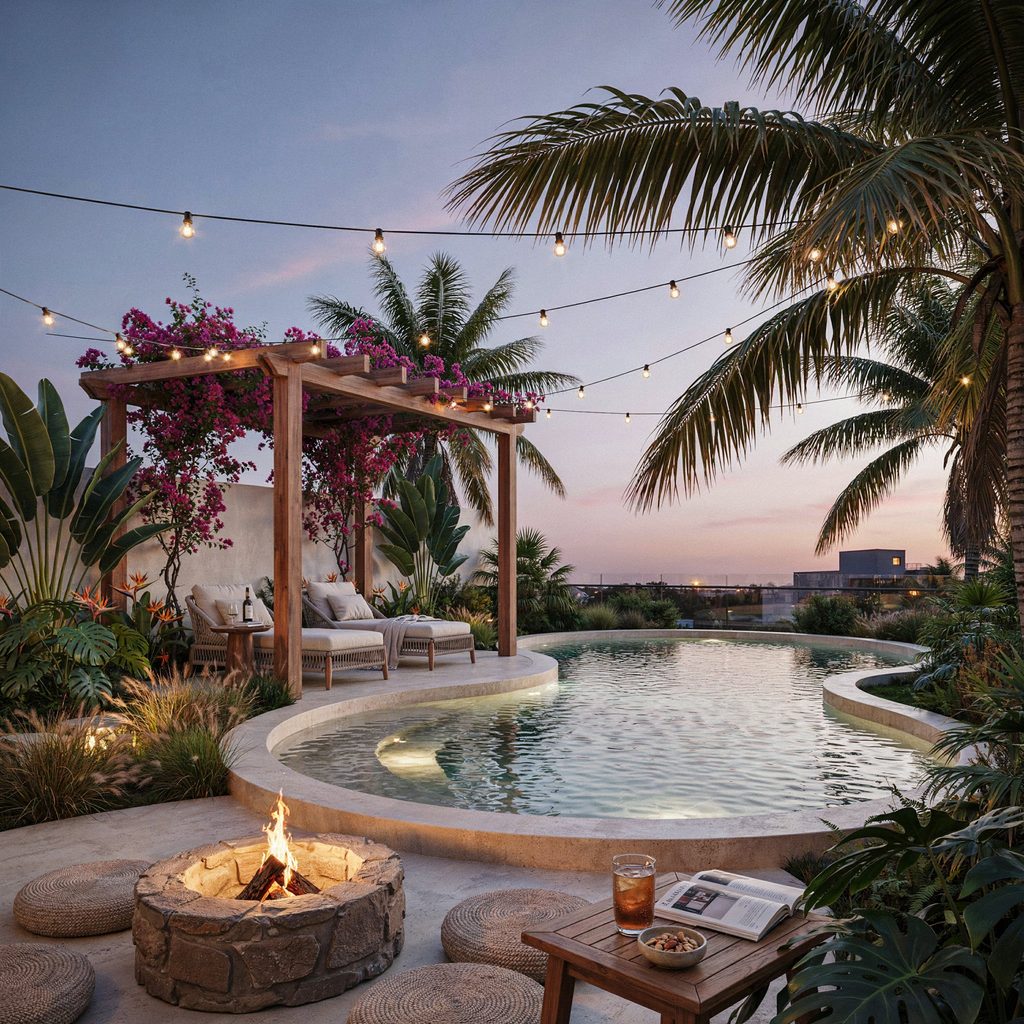
So what is a “resort-style vibe,” exactly? It’s a blend of luxury and ease. It’s intentional zones for swimming, dining, and unwinding. It’s sensory design: moving water, night-blooming jasmine, warm stone underfoot. Above all, it’s the feeling that someone thought of everything.
This guide walks you through nine practical steps to build that feeling at home. You’ll get backyard oasis ideas, realistic budget tiers, and climate-smart picks for every US region. Let’s turn your outdoor living space into the getaway you keep booking.
What Makes a Backyard Feel Like a Resort?
Luxury backyard design is not a shopping list. It’s a set of principles. Resorts feel calm because every sightline is intentional. Copy the intention, not the price tag.
Seven principles do most of the work:
- Zoning. Resorts never leave one big lawn. They create destinations: lounge, dine, swim, unwind.
- Layered landscaping. A canopy, a mid-layer, and groundcover create jungle-like depth.
- Water features. Sound, movement, and reflection mask street noise and signal calm.
- Shade and privacy. Pergolas, cabanas, and hedges build rooms without walls.
- Lighting layers. Ambient, task, and accent light extend the yard deep into the night.
- Material cohesion. Repeating the same stone, wood, and textile palette ties zones together.
- Sensory touches. Scent, texture, and sound complete the illusion.
“Landscape designers recommend designing for all five senses, not just the eyes.” A resort yard smells like jasmine. It sounds like a waterfall. It feels like smooth, sun-warmed stone underfoot.
Stack these principles and even a quarter-acre lot delivers true backyard resort vibes. The nine steps below apply them in order, from layout to lighting.
Step 1: Plan Your Layout and Zones
Start with graph paper or a free landscape app. Sketch the property line, the house, and existing trees. Then track two invisible forces for a week: sun and wind.
Map your microclimate. Note where the 4 p.m. sun lands in July. Note which corner catches winter wind. In the Southwest, western exposures fry, so shade structures belong there. In the Pacific Northwest, do the opposite: chase sun and block wind.
Draw an S-curve, not a straight line. A curved path slows the walk and reads as “designed.” Connect zones with gentle curves and let plants soften the edges. This is the core of smart landscape zoning ideas. Keep main paths at least 4 feet wide so two people can stroll side by side.
Typical resort zones include:
- Poolside lounge: chaises, a daybed, umbrella or cabana
- Outdoor dining: table for six to eight, shaded, near the kitchen
- Backyard fire pit area: a seating circle for late evenings
- Wellness corner: a level pad for yoga or meditation
- Outdoor kitchen and bar: grill, counter, cold drinks within reach
Check the rules before you fall in love with a plan. HOA setbacks often govern pergolas, sheds, and fences. Many CC&Rs also regulate visible structures. HOA friendly backyard design starts with one quick email to the architectural committee.
Budget tip: build one “hero zone” first — say, the pool and lounge. Finish it completely. Then add one zone per season. A finished corner beats a half-built yard.
Step 2: Choose a Resort-Inspired Style
Pick one style and commit. Cohesion separates luxury backyard design from a yard full of random purchases. Four styles work especially well across the US.
Tropical lagoon. Think palms, bird of paradise, and banana leaves. Add a dark pool finish and a tiki cabana. It’s ideal in USDA Zones 9–11: Florida, the Gulf Coast, Southern California. In Zone 8, substitute windmill palms and hardy bananas.
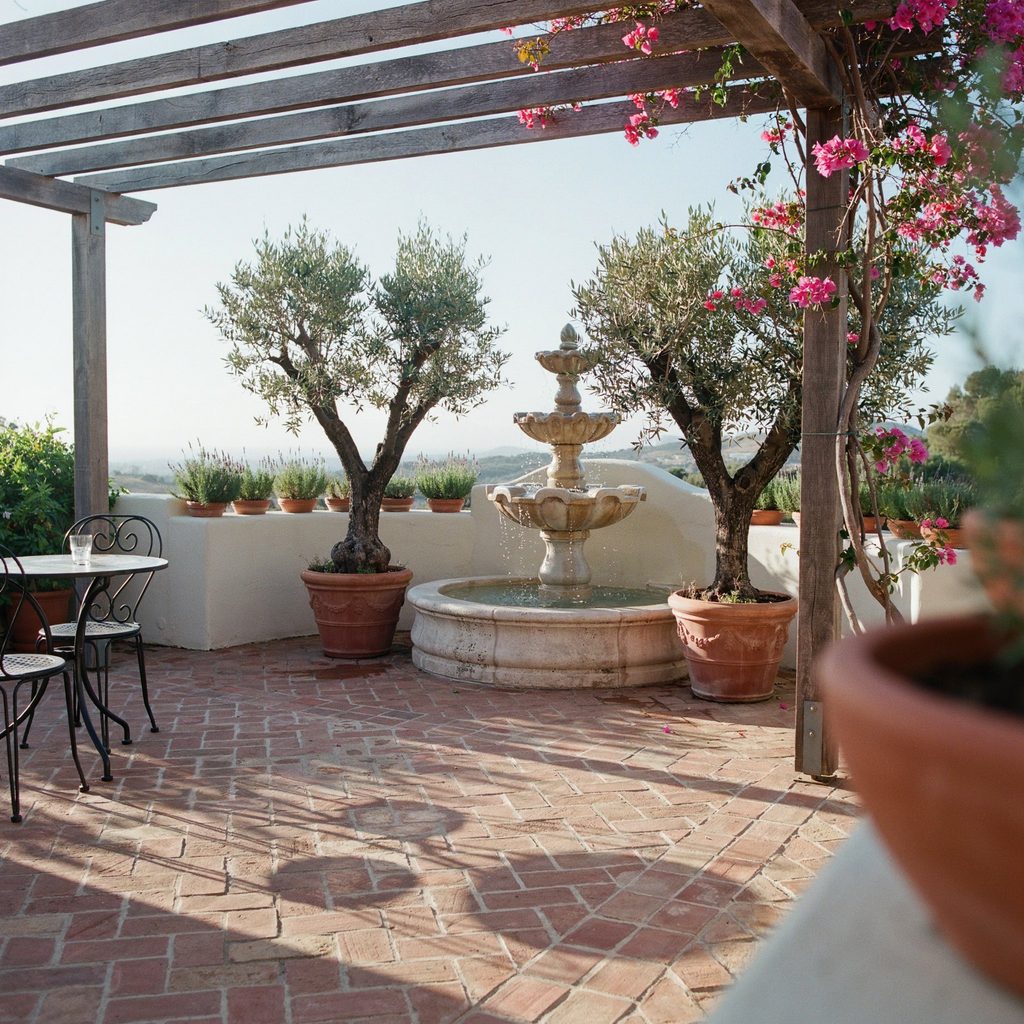
Mediterranean courtyard. Terracotta pots, olive trees, a shaded pergola, and a trickling fountain. Olives thrive in Zones 8–10 with sharp drainage. This style shines in California, Texas, and the Southwest.
Modern minimalist. Clean lines, large-format concrete pavers, a monochrome palette, and an infinity edge where the site allows. It’s the most climate-flexible style of all. In cold zones, simply swap tropicals for sculptural evergreens.
Desert oasis. Desert oasis landscaping with agave, yucca, and palo verde. Add a ramada for shade and a fire feature for night. Perfect for Southwest Zones 8–10, and it sips water all summer.
Match the style to your US climate zone landscaping reality, not to a Pinterest board. A tropical lagoon in Phoenix fights the desert. A desert oasis in Atlanta fights the rain. The right style works with your zip code.
Step 3: Hardscape and Materials That Elevate the Space
Hardscape is the skeleton of a modern backyard patio. Get it right and everything placed on top looks expensive.
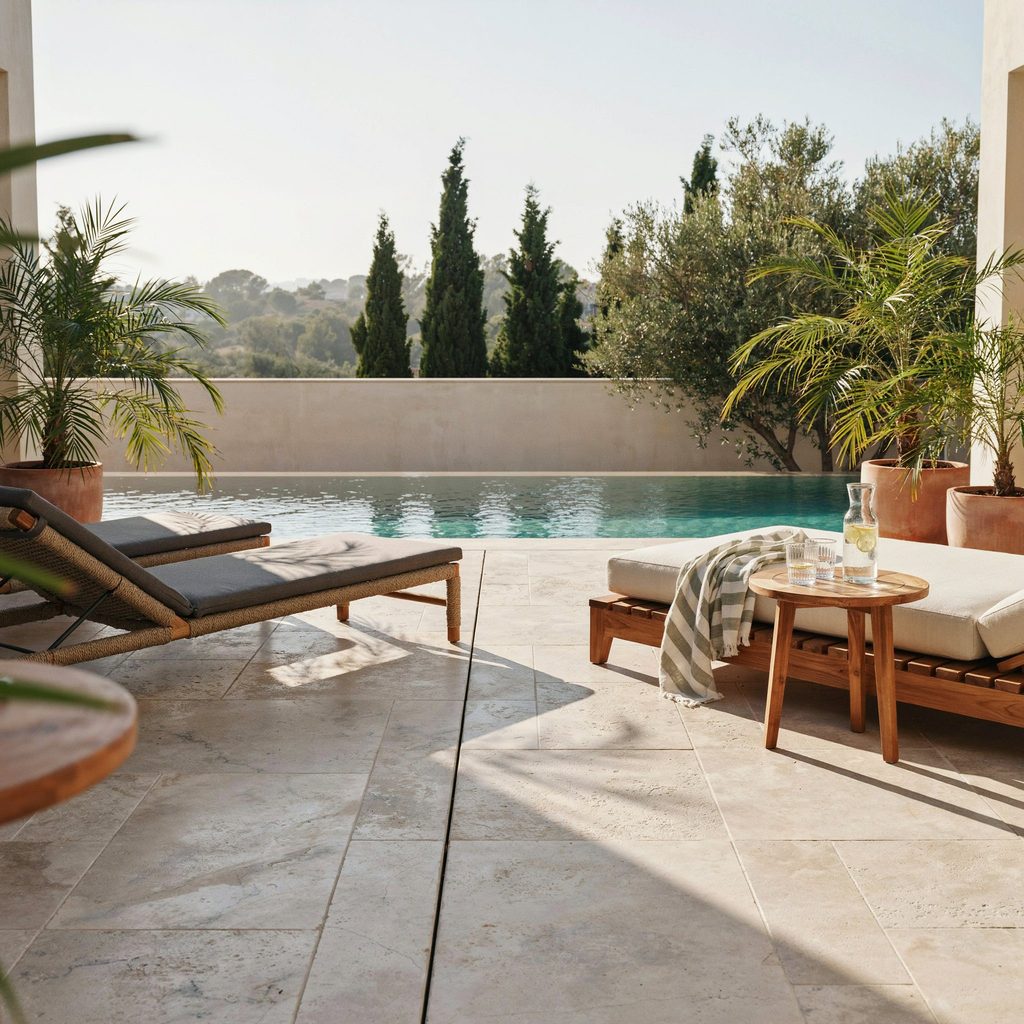
Decking and patios. Concrete pavers are the value pick: durable, replaceable, and HOA-friendly. Natural stone like travertine stays cool under bare feet — a poolside superpower in hot states. Composite decking resists rot and skips annual sealing. Whichever you choose, specify slip-resistant finishes near water.
Pool coping and finishes. Pebble Tec gives a natural lagoon texture. Dark plaster or charcoal finishes create the “bottomless” water resorts love. Light finishes sparkle. Dark finishes dramatize.
Pathways and transitions. Avoid straight runs. Use curved beds, irregular stepping stones, or gravel threaded with groundcover like thyme or mondo grass. Soft edges make new hardscape feel established.
Budget ranges (installed):
- Low: decomposed granite or gravel plus DIY pavers, $4–$10 per sq ft
- Mid: flagstone or pavers with composite accents, $15–$30 per sq ft
- High: custom stone, porcelain pavers, glass railings, $45+ per sq ft
Plan for American weather. In freeze-thaw states, insist on a compacted gravel base and polymeric sand so pavers don’t heave. In desert heat, leave expansion joints in long concrete runs. Around pools, choose salt- and chlorine-resistant sealers and reapply every two to three seasons. Ten minutes of spec-sheet reading saves years of repairs.
Step 4: Landscaping for a Lush, Layered Look
Tropical backyard landscaping wins on layers. Resorts plant in three stories, like a forest.
- Canopy: palms, olive trees, frangipani, or crape myrtles
- Mid-layer: hibiscus, philodendron, bird of paradise, ornamental grasses
- Groundcover: mondo grass, star jasmine, ferns, liriope
Buy the canopy big if the budget allows. One 15-foot palm transforms a yard the day it’s planted. “Specimen trees are the fastest luxury money can buy,” as designers often put it.
Choose pool friendly plants. Low litter and non-invasive roots are the rule. Skip trees that shower debris into the water. Good picks include clumping bamboo (never running bamboo), areca palms, and agaves sited away from bare feet.
Solve privacy in layers. Backyard privacy solutions work best stacked: an arborvitae or privet hedge as the base, a trellis with star jasmine for height, and raised planters to block seated sightlines. Clumping bamboo in planters adds instant tropical screening.
Region-by-region picks:
- Southeast: canna, crotons, hardy banana, Confederate jasmine
- Southwest: agave, yucca, desert museum palo verde, red yucca
- Northeast/Midwest: hydrangeas, hardy ornamental grasses, boxwood, hostas
Irrigate like a pro. Run drip lines under 2–3 inches of mulch. Pair them with a smart controller that reads local weather. Group plants by thirst, a trick called hydrozoning. A low maintenance backyard is really a well-zoned backyard.
Step 5: Water Features That Set the Mood
Water is the soundtrack of a resort. Water features for backyard use range from subtle to spectacular.
Popular options:
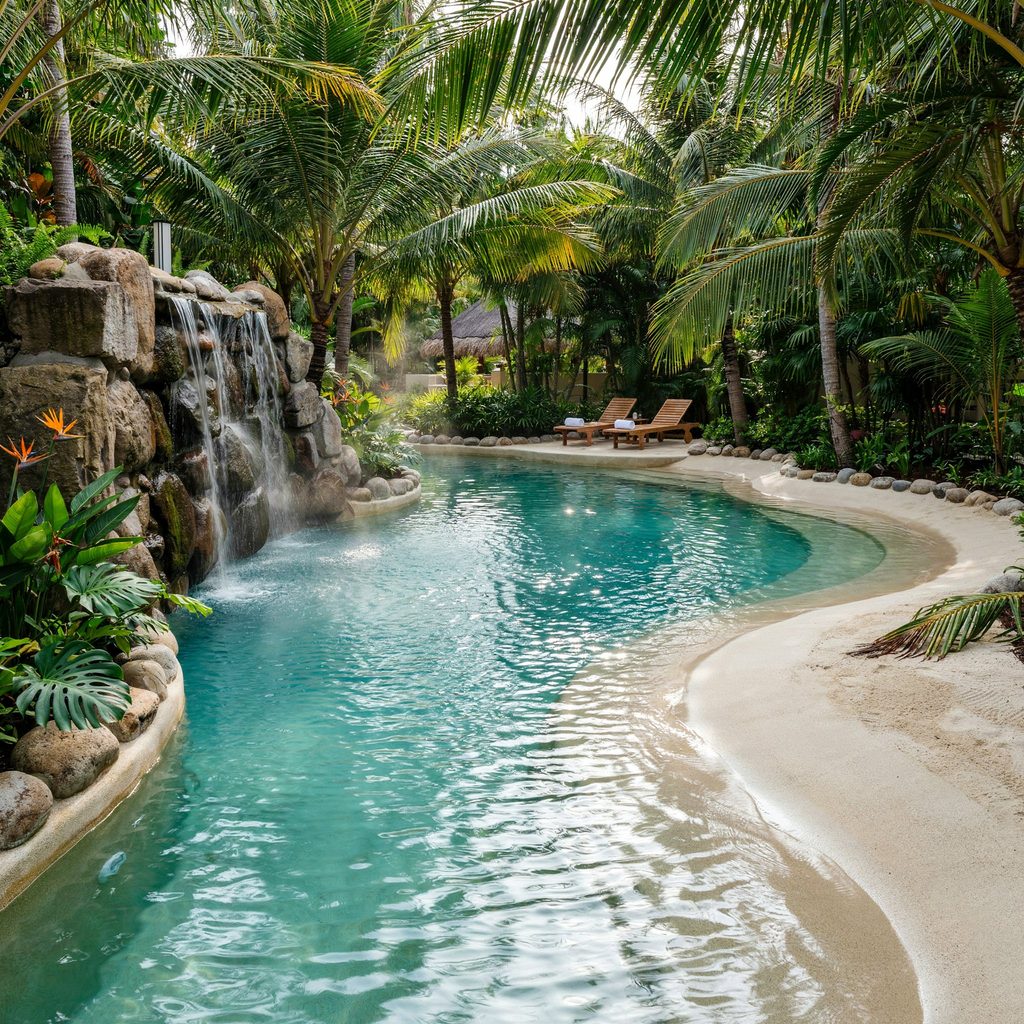
- Rock waterfalls and grottos for lagoon energy
- Beach (zero) entries for families and barefoot luxury
- Bubblers on a sun shelf for gentle sparkle
- Urn or bowl fountains for Mediterranean calm
- Fire-and-water combos for nighttime drama
Design the sound. A short, wide sheet of water whispers. A tall, narrow fall splashes. Higher drops mean louder sound — perfect for masking a busy street, less perfect for quiet conversation.
Budget paths. Prefab waterfall kits run $800–$3,000 for a handy DIYer. Custom boulder installations typically start near $6,000 and climb past $20,000 with grottos. Standalone fountains start under $300.
Safety and upkeep. Size the pump to the width of the fall; your supplier can chart this. In cold climates, plan to winterize: drain lines, pull the pump, store it dry. See our guide to [winterizing pools and water features] for a full checklist.
Step 6: Shade, Seating, and Comfort
Resorts sell comfort. Your yard should too. Start with shade, then add seating that invites a nap.
Shade structures. A pergola with a retractable canopy gives control at the turn of a crank. Shade sails are the budget hero. Tiki huts and cabanas deliver instant vacation energy. Among pergola and cabana ideas, the cabana with flowing outdoor curtains is the single most “resort” move on this list.
Seating that says stay. Choose deep outdoor lounge furniture with quick-dry foam. Add chaises in performance fabric, a daybed for two, and built-in benches around the fire pit. Built-ins multiply seats without clutter.
Textiles do the styling. Layer weather-resistant cushions, an outdoor rug, and throw pillows in resort palettes: sage, sand, navy, terracotta. A good rule: 60% neutral, 40% color.
A US-specific tip. In humid Southeast summers or high-UV Southwest skies, insist on solution-dyed acrylic fabric. It resists UV fade and mildew. Rinse monthly, and give cushions a dry-down day after rain. Comfort is a maintenance habit, not a one-time purchase.
Step 7: Lighting for Evening Ambiance
Backyard lighting design is where resorts leave ordinary yards behind. Use three layers.
- Ambient: string lights over the lounge, warm post lights at entries
- Task: grill light, dining pendant, step and path lights
- Accent: uplights on palms and olives, underwater pool glow, fire bowl flame
Get the temperature right. Choose warm white around 2700K. Cool white reads as parking lot, not paradise. Keep brightness low. Resorts glow; they don’t glare.
Go smart. Smart outdoor lighting lets you dim zones from your phone. Set a “dinner” scene at 60% and an “after-dark” scene at 25%. Timers handle the rest, and low-voltage LED keeps the power bill trivial.
Light for safety, invisibly. Place path lights every 6–8 feet, step lights on every riser, and pool edge illumination per local code. Guests should notice the mood, never the hazards.
Step 8: Outdoor Kitchen, Bar, and Entertaining
A backyard entertaining space earns its keep on Saturdays. Build to your real habits, not a magazine cover.
The essentials: a grill station with landing space, a mini fridge, a small sink, counter for prep, and one weatherproof cabinet. Wind protection matters more than square footage.
Bar ideas that wow: a shaded poolside counter, a swim-up bar if the pool budget allows, or a tiki bar under thatch for tropical themes. Even a rolling bar cart beside the lounge reads as hospitality.
Layout rule: keep the dining table within a few steps of the grill. Allow 36–40 inches (about 90–100 cm) of circulation behind pulled-out chairs. Nobody should squeeze past a hot skewer.
Budget tiers:
- Low: quality portable grill plus a stone-look cart, $600–$1,500
- Mid: modular stainless cabinets with grill and fridge, $3,500–$9,000
- High: built-in stainless, stone veneer, pizza oven, $15,000–$50,000+
For appliance picks and layout diagrams, see our guide to [outdoor kitchen essentials].
Step 9: Budget, Permits, and Maintenance
Let’s talk real numbers. Backyard renovation cost varies wildly, so plan in tiers.
Typical US cost ranges (installed):
- Landscaping and planting: $5,000–$20,000
- Patio and hardscape: $3,000–$15,000
- Inground pool: $50,000–$120,000+
- Pergola or cabana: $2,000–$10,000
- Lighting: $2,000–$6,000
- Irrigation: $2,500–$5,000
Permits: backyard permit requirements usually cover pools (with barrier and fencing codes), electrical work, gas lines, and structures over certain height or size limits. Fences near property lines can also trigger review. Call your local building department early. A $100 permit avoids a $10,000 redo.
Seasonal backyard maintenance, in brief:
- Spring: clean, mulch, service the pool, test irrigation
- Summer: deep-water trees, prune lightly, rinse fabrics
- Fall/Winter: winterize water features, drain lines, cover furniture
The ROI angle. A finished outdoor living space boosts backyard ROI and home value. Agents consistently report strong buyer appeal for turnkey outdoor rooms, often recouping half or more at resale. Meanwhile, the staycation value pays you back every single weekend.
Conclusion: Your Staycation Starts Now
You don’t need an acre or a trust fund to build a resort. You need a plan. Start small and think in zones. Layer plants and light. Prioritize shade, seating, and sound. Finish one hero zone completely, then let the yard grow outward season by season. These backyard staycation ideas all share that same DNA: one finished gesture, repeated over time.
Pick one “resort move” for this season. Plant a canopy palm. Hang string lights at 2700K. Add a bubbling urn by the patio. One finished gesture changes how the whole yard feels.
Then enjoy the payoff. Morning coffee under the pergola while jasmine hums. Kids cannonballing into a lagoon-dark pool. Friends lingering at the fire pit long after dessert. That’s the resort. It was always going to be your backyard.
Resort-Style Backyard FAQ
How much does a resort-style backyard cost?
Most US homeowners spend $10,000–$50,000 on a phased makeover without a pool. Add an inground pool and plan on $60,000–$150,000 all-in. Starting with one hero zone keeps year-one costs near $5,000–$15,000.
What plants are best for a tropical backyard in the US?
In Zones 9–11: palms, hibiscus, bird of paradise, and star jasmine. In Zone 8 and colder: windmill palms, hardy bananas, cannas, and ornamental grasses deliver the look with real winter hardiness.
Do I need a permit for a pool, pergola, or fire pit?
Usually yes for pools (barrier codes) and for electrical or gas work. Pergolas over certain heights and gas-burning fire pits often need review too. HOAs may add approval steps. Always check locally.
How do I get privacy without a tall fence?
Layer a hedge (arborvitae, privet), a trellis with climbers, and raised planters. Clumping bamboo in planters adds height fast where fence heights are limited.
Will a resort backyard increase my home’s value?
Well-executed outdoor living spaces boost curb appeal and buyer interest, and can recoup a meaningful share of cost at resale. The bigger return is use: a yard you actually live in.