
The American backyard is undergoing a quiet revolution. Gone are the days of sprawling freeform lagoons, stacked-rock waterfalls, and busy tropical plantings that compete for attention. In 2025 and 2026, the most coveted luxury backyards share a single philosophy: restraint. Minimalist pool designs have moved from niche architectural statements to the dominant language of high-end residential outdoor living across the United States.
Homeowners from Scottsdale to the Hamptons are trading ornate resort-style pools for clean geometries, monochrome palettes, and deliberate negative space. The result? Outdoor rooms that feel like extensions of the architecture itself—calm, intentional, and strikingly beautiful without shouting for attention.
This shift isn’t merely aesthetic. A minimalist swimming pool demands fewer materials to maintain, integrates more seamlessly with contemporary home design, and ages gracefully without the visual clutter that dates a landscape within a decade. Whether you’re an architect specifying a custom build, a landscape designer refreshing a client’s yard, or a homeowner dreaming of a serene weekend escape, understanding the principles behind less is more pool design will reshape how you think about water in your landscape.
Below, we break down the shapes, materials, landscaping strategies, and smart technologies that define the best modern pool design work happening in the US right now.
What Defines a Minimalist Pool?
Core Principles of Architectural Pool Design
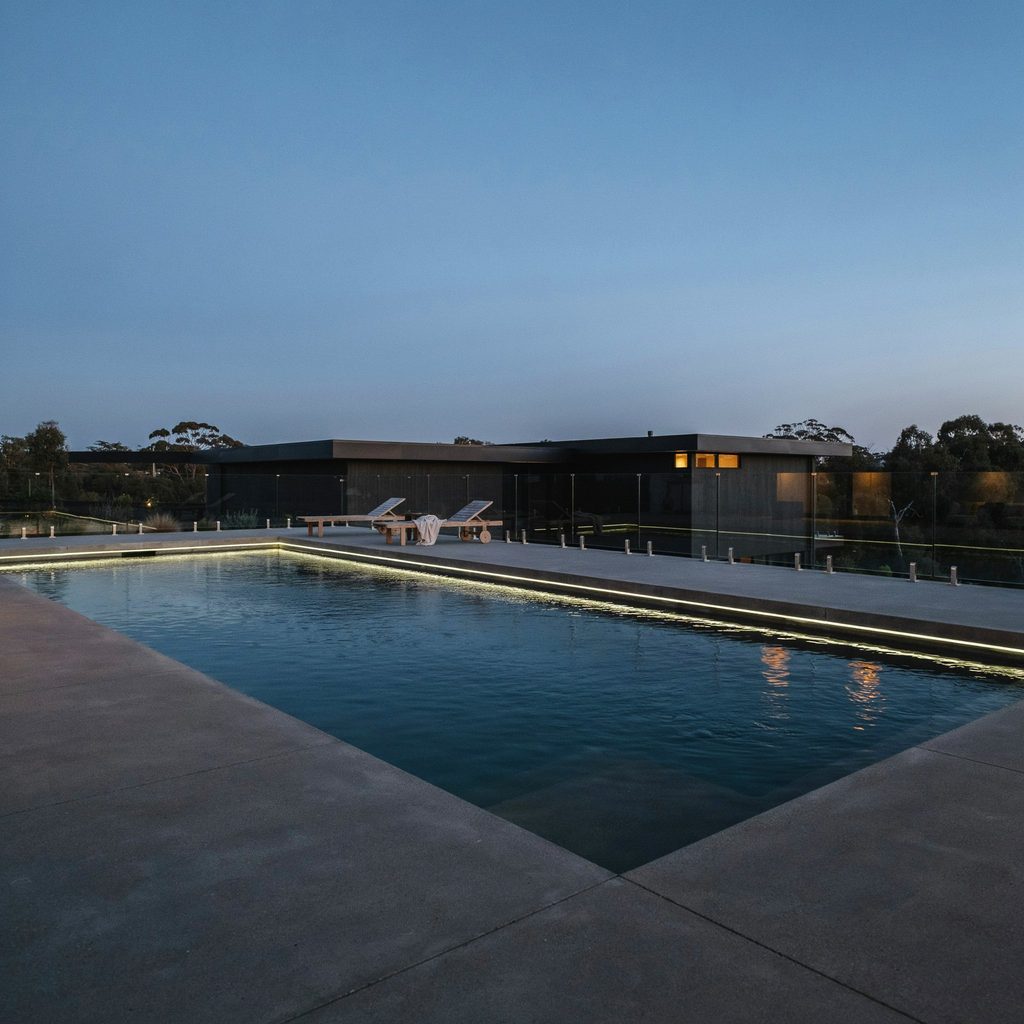
A minimalist pool isn’t simply a rectangle filled with water. It’s a carefully composed element governed by four non-negotiable principles:
- Clean geometry. Every edge is deliberate. Sight lines align with the home’s architecture, and no curve or angle exists without purpose.
- Limited material palette. Two to three materials—never seven. The restraint lets each surface breathe and draw the eye.
- Intentional negative space. The area around the pool matters as much as the pool itself. Wide coping, open decking, and uncluttered sight lines give the design room to resonate.
- Hidden mechanics. Pumps, filters, skimmers, and cleaning systems vanish behind flush grates, concealed equipment pads, or below-grade vaults. Nothing mechanical interrupts the visual calm.
How It Differs from Traditional Pool Design
Traditional pools often layer features: a waterfall here, a grotto there, multicolored stone coping, and dense tropical plantings crowding the deck. A clean line pool strips all of that away. The water itself becomes the focal point—its surface, its color, its reflection.
Architectural pool design treats the pool as a built structure, not a landscaped garden. Think of it as the outdoor equivalent of a Scandinavian interior: every element earns its place, and anything that doesn’t serve the composition is removed.
Top Minimalist Pool Shapes for US Homes
Rectangular Lap Pools
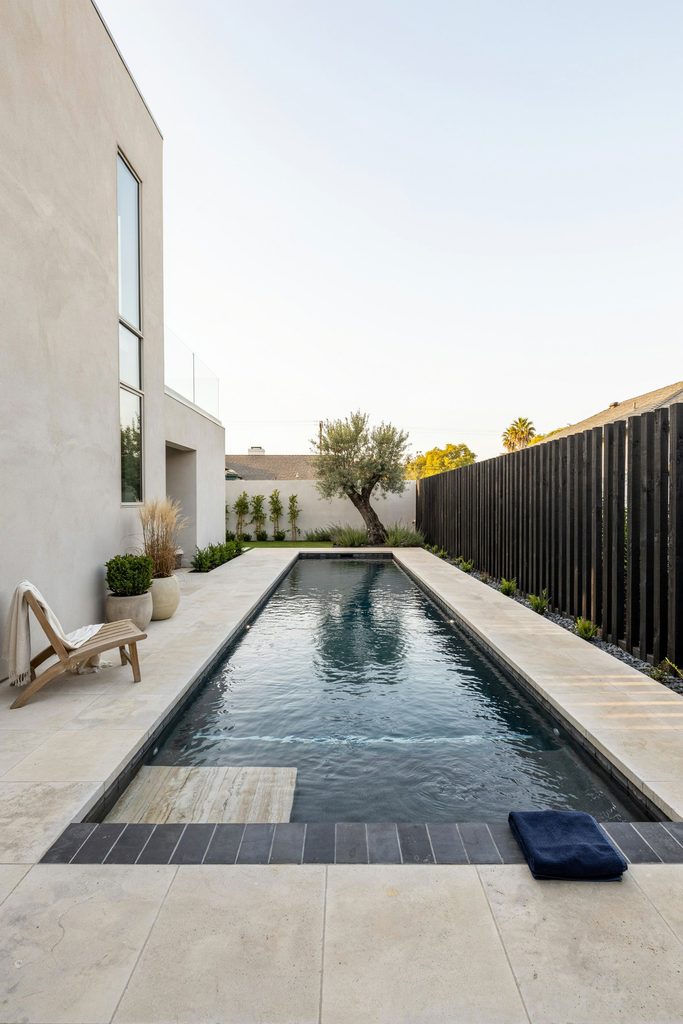
The rectangular lap pool remains the gold standard of geometric pool shapes. Ranging from 40 to 75 feet long and 8 to 12 feet wide, it suits narrow urban lots, side yards, and long rectangular backyards. Its straight edges echo the lines of modern homes, and its simplicity makes it endlessly adaptable—pair it with a tanning ledge at one end or a negative edge at the other.
Sharp L-Shaped and Linear Geometric Pools
For homeowners who want more than a single rectangle, an L-shaped or T-shaped footprint adds functional zones (a swim lane plus a shallow lounge area) without introducing curves. Custom geometric pool shapes like these let designers respond to irregular lot lines while keeping every angle crisp and intentional.
Plunge Pools for Compact Urban Lots
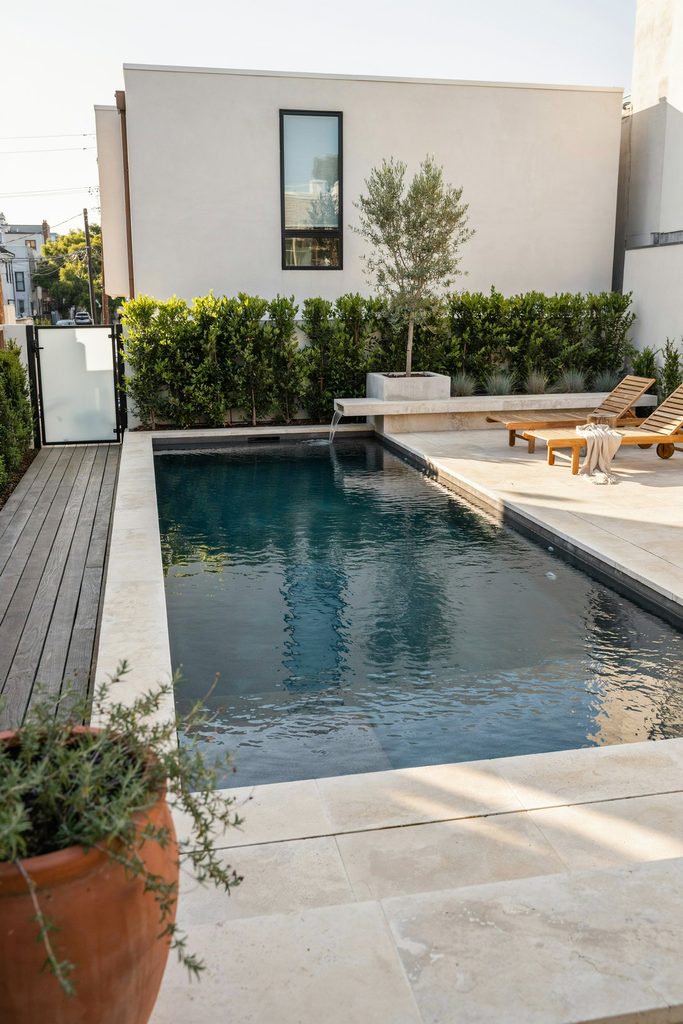
The plunge pool minimalist format—typically 10 × 14 feet or smaller—has exploded in cities like Austin, Denver, and Brooklyn. These compact pools deliver the sensory pleasure of water without demanding 600 square feet of yard. Paired with a built-in bench jet or a small spillover spa, they punch well above their footprint.
Infinity and Zero-Edge Pools
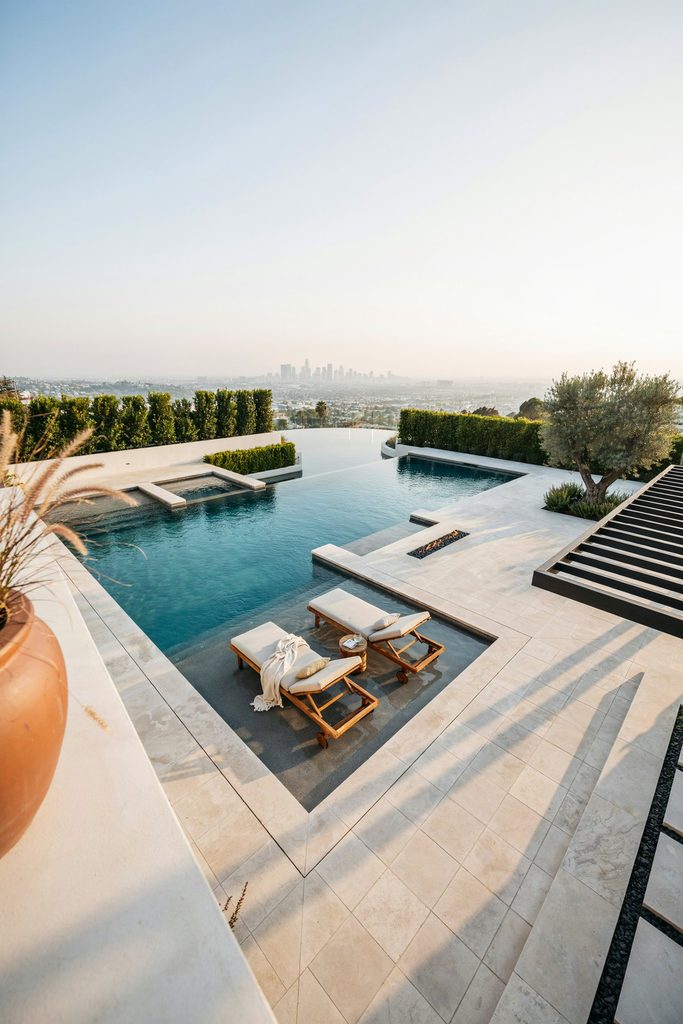
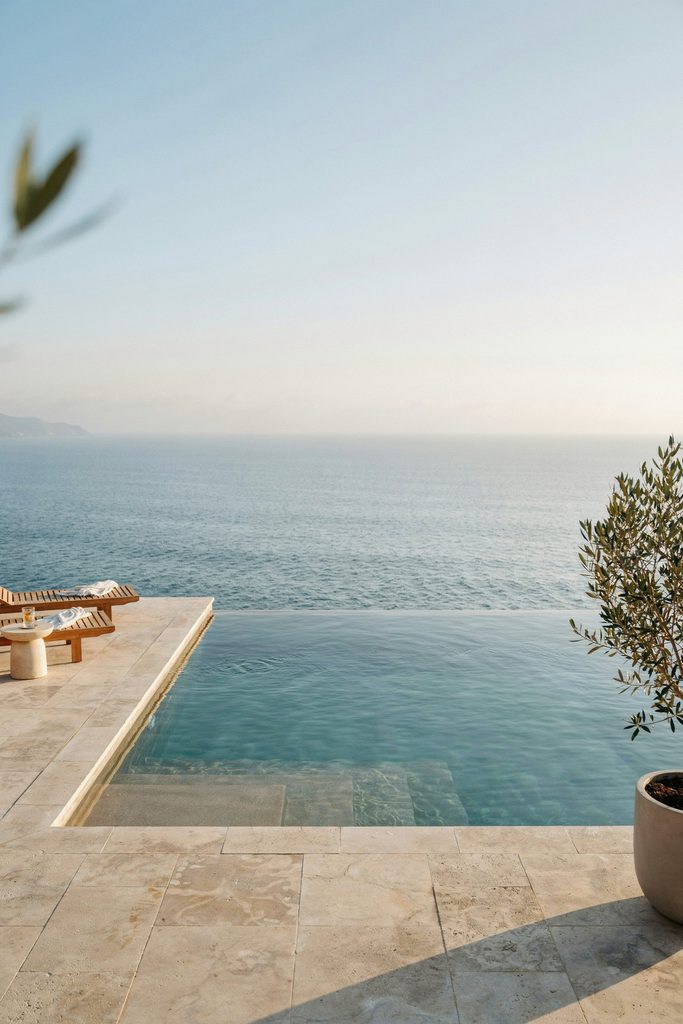
Where a property meets a view—ocean, canyon, skyline—an infinity edge pool or zero-edge pool turns the horizon into part of the design. Water spills over one or more edges into a hidden catch basin, creating the illusion that the pool merges with the landscape beyond. The effect is dramatic, but the surrounding architecture stays clean: no rockwork, no planted borders, just water meeting sky.
Negative Edge Pools for Sloped Sites
A negative edge pool (a close cousin of the infinity edge) works on sloped lots where the vanishing edge drops toward a lower terrace. It’s a favorite in California hillside builds and Colorado mountain properties, where terrain becomes an asset rather than a constraint.
Material & Finish Choices That Elevate Simplicity
Dark and Monochrome Interior Finishes
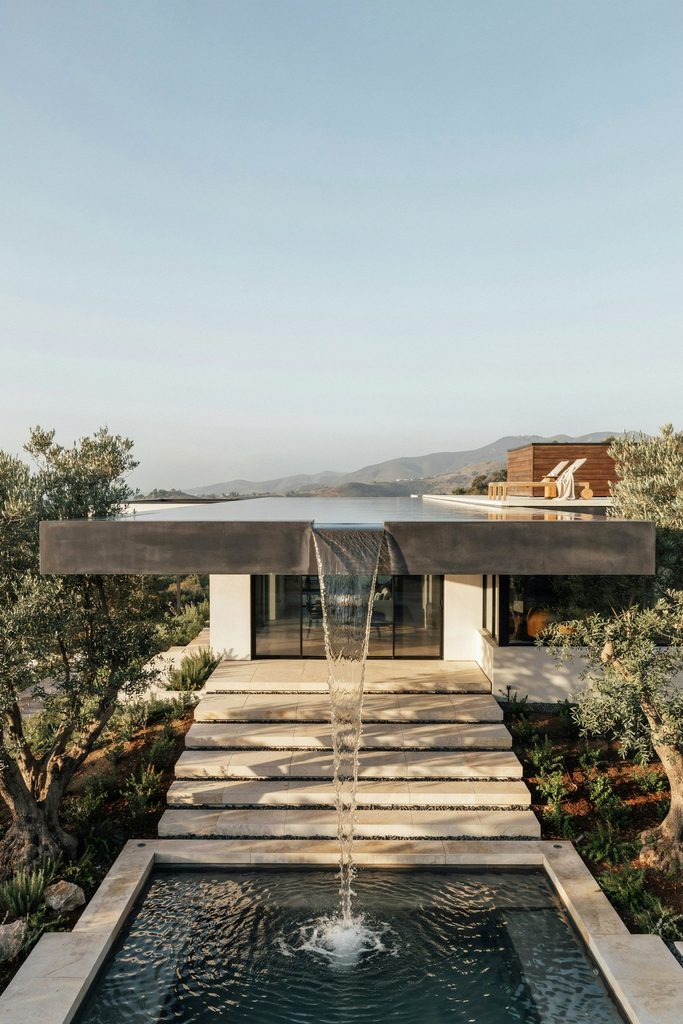
The single biggest trend in luxury minimalist pool interiors is the move away from bright aqua plaster. Dark plaster pool finishes—charcoal grey, deep navy, and midnight-black pebble aggregates—transform the water into a reflective, mirror-like surface. A charcoal pool interior absorbs light, making the pool read as a calm, inky plane rather than a glowing turquoise hole. For homeowners who prefer warmth, neutral pool finishes in warm sand, soft taupe, or pale grey keep the palette quiet while reflecting more sunlight.

Large-Format Decking
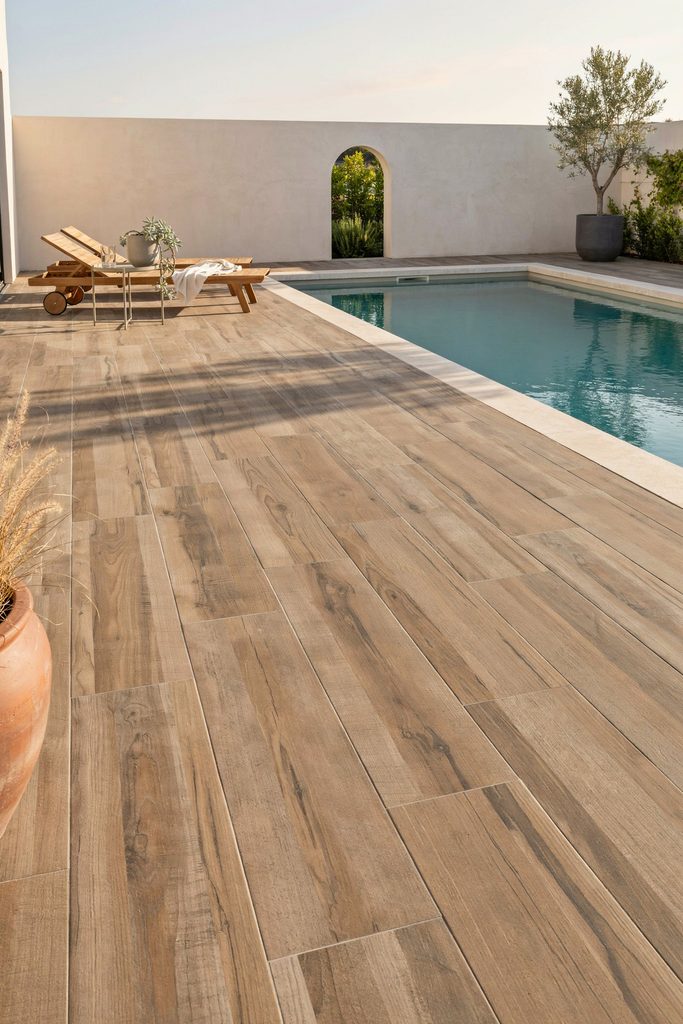
Around the pool, large-format porcelain pavers (24 × 48 inches or larger) have replaced busy cobblestone and small-format tile. Their minimal grout lines create a nearly seamless expanse that visually expands the deck. Textured, slip-rated finishes in concrete-look or stone-look porcelain deliver the warmth of natural material with superior durability and near-zero maintenance.
Frameless Glass and Flush Coping
A frameless glass pool fence preserves sight lines that traditional metal or mesh fencing destroys. Panels clamp into a concealed base channel, leaving nothing between the viewer and the water. Similarly, seamless pool coping—where the deck material meets the water’s edge in a flush, bullnose-free transition—eliminates the visual “lip” that breaks the pool’s clean geometry.

A Quick Material Checklist
- Interior: dark or neutral plaster / pebble aggregate
- Deck: 24×48-inch porcelain pavers or honed limestone
- Coping: flush, same material as deck for continuity
- Fencing: frameless glass or hidden mesh (where code allows)
- Accents: brushed stainless steel or matte black hardware only
Landscaping & Hardscaping for a Minimalist Look
Plant Less, Choose Better
Minimalist pool landscaping rejects the “more greenery equals more luxury” mindset. Instead, designers specify a tight palette of structural plants: ornamental grasses (muhly, feather reed), architectural succulents (agave, aloe), and a handful of native perennials. In arid regions like Arizona, Nevada, and Southern California, a drought-tolerant pool deck surrounded by decomposed granite, gravel borders, and low-water groundcovers eliminates thirsty turf entirely.
Lighting as Architecture
Linear LED pool lighting transforms a minimalist pool after dark. Thin, recessed LED strips embedded along the pool’s perimeter, beneath coping overhangs, or set into deck joints cast a soft, even glow without visible fixtures. Pathway lighting follows the same logic: low-profile bollards or recessed step lights guide movement without cluttering the landscape.
Built-In Seating and Fire
Rather than freestanding furniture, modern outdoor living spaces integrate seating into the hardscape. A poured-concrete bench with a thin cushion, a low Corten-steel fire bowl, or a minimalist seating wall doubles as a retaining element and a gathering spot. The effect is resort-style minimalist pool luxury without the visual noise of a dozen mismatched lounge chairs.
Hardscape Restraint
Decomposed granite walkways, board-formed concrete walls, and a single species of hedge (boxwood, privet, or Japanese holly) keep the composition disciplined. Every element repeats at least twice in the design to create rhythm without variety overload.
Smart Features That Keep It Simple (but High-Tech)
Hidden Equipment, Visible Calm
A true luxury minimalist pool conceals every mechanical component. Hidden pool equipment—pumps, heaters, salt chlorinators, robotic-cleaner docks—lives in a below-grade vault, a screened equipment courtyard, or a ventilated enclosure clad in the same material as the surrounding wall. The backyard sees water and stone; the machinery stays invisible.
Automation and Efficiency
Modern pool systems automate chemistry, filtration cycles, and lighting scenes from a single app. Saltwater generators eliminate the need to store and dose chlorine. Robotic cleaners navigate the pool floor on their own schedule. Color-tunable LEDs shift from warm amber to cool white with a tap, adapting the pool’s mood from afternoon swim to evening dinner party.
Integrated Spa and Tanning Ledges
An integrated spa and pool combination—where the spa spills into the main vessel through a narrow weir—keeps the footprint unified. Likewise, a tanning ledge (also called a Baja shelf) extends 6 to 12 inches below the waterline at one end of the pool, creating a shallow sunbathing platform that reads as part of the pool’s geometry rather than an added accessory.
Minimalist Pools for Small US Backyards
Maximizing Impact in Tight Spaces
Not every lot accommodates a 60-foot lap lane. Small backyard pool ideas prove that restraint scales beautifully. A 10 × 20-foot rectangular plunge pool centered in a courtyard, flanked by two symmetric planting beds, delivers the same architectural presence as a pool three times its size. Narrow side-yard lap pools (as slim as 7 feet wide) fit between a house and a property line, turning dead space into a daily-use amenity.
Design Tricks for Compact Footprints
- Reflective surfaces. A dark interior and still water double the perceived depth and mirror surrounding architecture.
- Monochrome materials. Using one paver, one coping stone, and one planting species eliminates visual fragmentation.
- Strategic lighting. Uplighting a single specimen tree or washing a concrete wall with a grazing LED makes a small yard feel layered at night.
- Vertical interest. A single green wall or a row of clumping bamboo draws the eye upward, expanding the sense of space.
Simple pool design ideas like these prove that square footage is less important than composition.
Cost Considerations & Working With a Builder
Why Minimalist Doesn’t Mean Cheap
A common misconception: fewer features equal a lower invoice. In practice, a custom geometric pool demands tighter tolerances, perfectly level coping, and flawless plaster application because there’s no rockwork or planting to hide imperfections. Precision costs money. Expect pool construction costs for a high-end minimalist build to range from $80,000 to $250,000+, depending on size, site access, and finish selections.
Questions to Ask Before You Hire a Pool Builder
- Can you show me three completed projects with exposed aggregate or dark plaster finishes?
- How do you handle equipment concealment and drainage on a flush-coping design?
- What is your tolerance for coping levelness (ideally ≤ 1/16 inch over 10 feet)?
- Do you coordinate with landscape architects and structural engineers in-house?
- What warranty covers the interior finish against mottling or delamination?
Asking these questions early separates builders experienced in architectural pool design from those who default to cookie-cutter shapes.
Real-World Inspiration: 4 Mini Case Studies
The Hamptons Rectangular Retreat (Long Island, NY)
A 55 × 14-foot rectangular lap pool clad in charcoal pebble finish, bordered by 24 × 48-inch honed bluestone pavers. Frameless glass fencing preserves dune views. Landscaping: a single row of clipped boxwood and three multi-stem birch trees. No waterfall, no slides—just water, stone, and sky.
The Sonoran Plunge (Scottsdale, AZ)
An 11 × 13-foot plunge pool minimalist build set into a decomposed-granite courtyard. Midnight-black plaster, a built-in bench with a single bubbler jet, and a Corten-steel fire bowl six feet away. Surrounding plantings: three agaves, a lone ocotillo, and buffelgrass. Total water footprint under 2,000 gallons.
The Pacific Infinity Edge (Malibu, CA)
A 42 × 12-foot zero-edge pool cantilevered over a coastal bluff. The vanishing edge drops toward the Pacific; the catch basin hides below a board-formed concrete terrace. Interior finish: deep navy plaster. Decking: large-format porcelain in warm grey. One olive tree, one concrete bench, linear LED strips along the coping.
The Urban Rooftop Lap Pool (Chicago, IL)
A 30 × 8-foot rectangular lap pool engineered into a reinforced rooftop structure. Charcoal glass-tile interior, flush stainless-steel coping, and a frameless glass wind screen. Equipment lives in a mechanical penthouse below. At night, color-tunable LEDs shift the water from warm gold to cool blue, reflecting off the skyline.
Conclusion
Minimalist pool designs endure because they resist trends. A clean geometric form, a restrained material palette, and disciplined landscaping create an outdoor room that looks as relevant in 2035 as it does today. There are no gimmicks to tire of, no ornate features to repair, no cluttered plantings to replace every three seasons.
The less is more pool philosophy asks one thing of its owner: the confidence to let space, light, and water do the work. Every material earns its place. Every line serves the composition. The result is a backyard that feels like exhaling.
Ready to design your minimalist pool? Start by sketching your ideal geometry—rectangle, L-shape, or compact plunge—and talking to a builder who specializes in modern, architectural pools. Bring inspiration images, ask about finish samples, and insist on seeing completed projects in person. Your future backyard will thank you for the restraint.